
Jun 25, 2026
Active Chilled Beam Short Circuiting
3 January 2024|Air Distribution, Chilled Beams, Consulting Engineer, HVAC
by Nick Searle
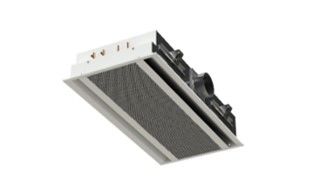
One aspect of Active Chilled Beam (ACB) system layout that is rarely considered is short circuiting. Short circuiting can lead to system performance issues and air distribution problems if not correctly addressed at the design stage.
Short circuiting occurs when two or more rows of linear ACB’s are laid out with a spacing that is too narrow to allow the colliding air streams to direct the mixed air vertically down towards the occupied zone. The supply air stream of one of the chilled beam rows forces the airstream of the adjacent row to detach from the ceiling and be drawn into its induced air path.
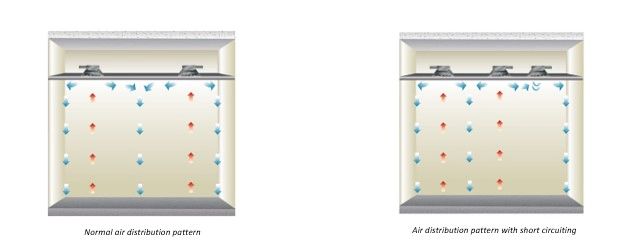
When an ACB induces its own supply air stream, the water coil is not absorbing the space heat gains as intended and the beam will not perform comparably to its cataloged data, resulting in a shortfall in cooling or heating performance. Short circuiting can also occur if ACB’s are located at the perimeter without sufficient spacing between the ACB supply slot and glazing/wall.
Short circuiting can occur in rooms/zones where the sensible heat gains exceed around 15 watts/ft2, forcing the engineer to densely pack the beams into the ceiling, in some instances leaving only a single (24”x24”) ceiling tile between rows of beams. In extreme cases, I have seen 2-way throw beams located immediately adjacent to one another, with the primary air connected in series with a 180° duct bend.
For these reasons, additional care should be taken when selecting ACB’s for high cooling load applications. The following guidelines will help avoid short circuiting in these types of applications:
- Ensure the centerline spacing between rows of beams is at least 6'.
- Perimeter beams should be located so that there is at least 3’ from the centerline of the ACB and perimeter wall/glazing, i.e., a single 24”x24” ceiling tile between the beam and perimeter. If this is not possible, a 1-way throw beam can be used and positioned immediately adjacent to the perimeter with the active supply air slot throwing into the room (not towards the glazing).
- Select high performance ACB models with multi-circuit coils such as the Titus CBAL-24 – this results in fewer beams wider spacing between rows.
- Zone cooling loads exceeding 15-20 watts/ft2are likely to force close spacing of the ACB’s, so for these scenarios, consider using a fan powered sensible cooling terminal unit such as the Titus DLSC which can be used in zones with very high loads without the risk of short circuiting.
- Regardless of loads, always check that the air velocities between colliding airstreams are 50 fpm or less in the occupied zone for applications requiring good thermal comfort.
Active chilled beams are ideal for zones with high sensible loads, however, there is an upper limit to the loads the system can handle, so additional care must be exercised to ensure the overall system will perform as designed if the loads are greater than around 12 watts/ ft2.
For additional information on chilled beams visit us at www.titus-hvac.com.