
Jun 22, 2026
Free Area vs. Effective Free Area
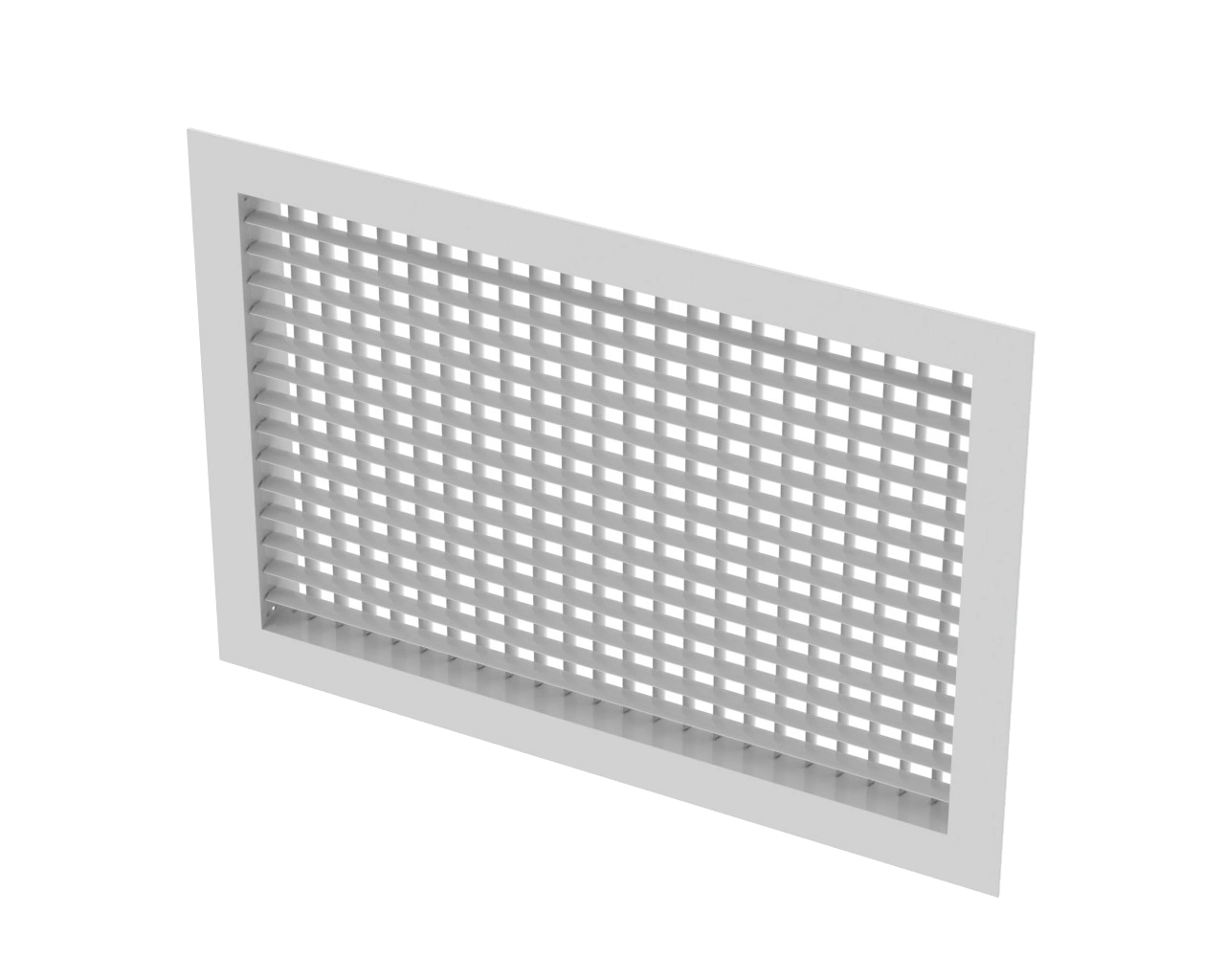
Each year, I receive numerous requests for free area data for diffusers and grilles. It’s important to understand that there are two different types of free area:
- Free Area – This is the actual free area of an air outlet. After subtracting the frame dimensions, all the unobstructed openings in the face of the product must be determined and added together to calculate the free area. This can be thought of as the true or geometric free area. This is very straight forward for many types of grilles, but it can be difficult or impossible to determine for diffusers with curved back pans, louvers, cones, blades, and pattern controllers.
- Effective Free Area – This can only be determined through lab testing. The product must receive supply air from an air measuring station. Velocity readings are then taken at various documented points across the face or along the length of the outlet. The readings are taken using either a hot wire or vane anemometer, depending on the outlet type. Then the readings are averaged to calculate a face velocity. Since the air volume is known, it can then be divided by the face velocity to calculate the effective free area. This can be easily determined for any type of grille or diffuser regardless of configuration.
So, which free area is more useful? Most of the people requesting free areas expect to receive the actual or true free area of a product, but this is a mistake. Although there may be some limited value in knowing actual free area, the effective free area is much more important. Rather than just telling us the size of the outlet, effective free area tells us how the product will perform.
Effective free area looks beyond all the complications of an outlet design and simply provides the resulting performance. We know that many features affect the way air moves. Air moves most efficiently through round openings and doesn’t fill the corners of rectangular openings. One large opening will perform differently than an equal size opening consisting of smaller openings. Air moves differently through openings in thin materials than it does through thicker materials or deep channels that may function as nozzles. Air also tends to hug curved surfaces like back pans, cones, and airfoil blades. Therefore, it is more important to know how an outlet performs than know its geometric size.
What’s the difference between effective free area and the area factor (Ak) that we may publish for a product? Well, they could be the same, but they probably aren’t. The test process that I described for determining the effective free area is simple, if you plan to test every unit size. That isn’t practical for products that come in many different and possibly hundreds of sizes. Therefore, a select number of sizes are tested and then an area factor is determined that can be used to predict performance across all sizes.
Hopefully, I have explained this fairly complex topic in an easy-to-understand manner.
Randy Zimmerman
Chief Engineer